You Own Three LLCs and Pay for Everything From One Card. Here's What It's Doing to Your Books.
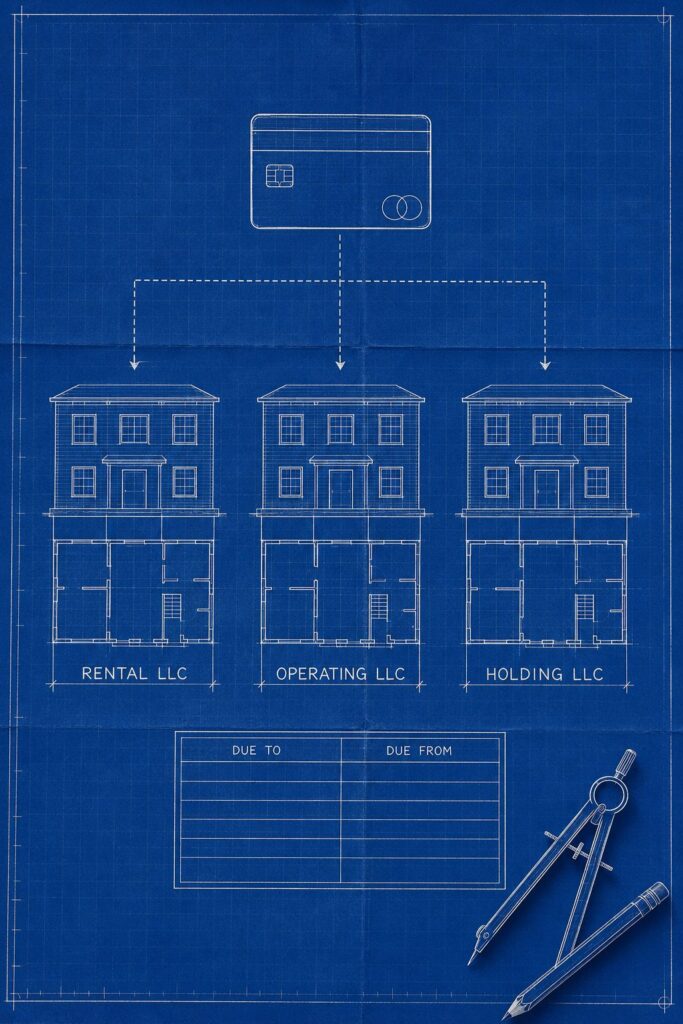
You set up three LLCs because someone told you to. One for the rental property, one for the operating business, one to hold it all. Good advice. Then you went about your life: the rental’s roof got paid from the business card because that’s the card in your wallet, the insurance for all three got wired from the holding company, and you moved $20,000 from the business to the rental “to cover the mortgage” and didn’t write anything down.
We run an accounting firm, and we see this every month. It’s the most common way a multi-entity structure quietly stops doing its job. Here’s what’s actually happening in your books when you do it, and why it matters more than it feels like it should.
Every one of those payments is a loan
When the business pays the rental’s roof, the business has lent the rental money. That’s not an accounting opinion. It’s what happened. The correct record is a receivable on the business’s books and a matching payable on the rental’s, and the two have to agree to the penny.
The problem is that when nobody makes that entry, the roof shows up as a repair expense on the wrong company, and never shows up on the rental at all. The rental looks more profitable than it is. The business looks less profitable than it is. And the loan between them, the thing that would explain the difference, doesn’t exist anywhere.
Do that forty times over a year and by tax time there’s a five-figure gap between what each company thinks it owes the other, and nobody can reconstruct which roof went where.
Why your attorney cares
The entire reason to have separate LLCs is that the money doesn’t mix. When it mixes, you’ve handed a plaintiff’s attorney their favorite argument: that the entities aren’t really separate, that they’re just different names on one wallet, and that the liability protection you set them up for shouldn’t apply. The technical term is “piercing the veil,” and commingled funds are exhibit A.
A properly booked loan between entities isn’t commingling. “I used whichever card I had” with no record is.
Why your lender cares
When you go for the refinance, the lender asks for the rental’s financials. If the balance sheet shows a big “due to affiliate” line, the underwriter’s question is: what happens when the affiliate wants its money back? If it shows a big “due from affiliate,” the question is: is that collectible, or is that company broke?
A clean, small, documented intercompany balance is a rate. A large, unexplained one is a conversation, and sometimes a decline.
Why it matters at tax time
Your share of each company’s income, and your basis in it, depends on what you put in and took out. Was that $20,000 a loan from the business to the rental? A capital contribution? You taking a distribution from one and putting it into the other? Three different answers, three different tax outcomes, and it becomes very real the year you sell the property.
The number to watch
Ask your accountant for one thing: the intercompany schedule. What does each company owe the others, right now? Most owners have never seen it. The first time you see “the rental owes the business $61,000” is the first time you understand that the rental isn’t carrying itself, and that’s a decision you’d rather make in July than discover in March.
If the balance grows every month and never clears, it means one of three things: one company can’t pay its own bills, you’re treating them as one wallet, or money is being moved without anyone deciding what it is. All three are fixable. None of them fix themselves.
The habit that keeps it at zero
- Pay each company’s bills from that company’s account. Boring, effective, and the whole game.
- When you can’t, tell your accountant the same week. “Business card paid the rental’s roof, $8,400.” That’s a two-line entry if they hear about it now and a forensic project if they hear about it in March.
- Name every transfer. Loan, contribution, distribution, or reimbursement. If you don’t know, say so and let your accountant help you decide, this month.
- Settle up. If the rental has the cash, pay the business back. A loan that sits for years should have a note and an interest rate, or it should have been called a contribution in the first place.
Where we come in
Multi-entity books are most of what we do. We book both sides of every intercompany transaction the month it happens, tie the balances across your entities every close, and show you the schedule so you always know which company is carrying which. If you own more than one entity and you’ve never seen your intercompany schedule, reach out. We’ll pull it together and tell you honestly what it says.